Cursive Alphabet Chart — Master the A-Z Script
The complete guide to cursive letters. From elegant uppercase to flowing lowercase, explore every stroke of the alphabet. Perfect for students, teachers, and handwriting enthusiasts.
Every letter in cursive (A–Z chart)
Download a single-page chart with every uppercase and lowercase letter, then open any cell below for stroke order and joins.
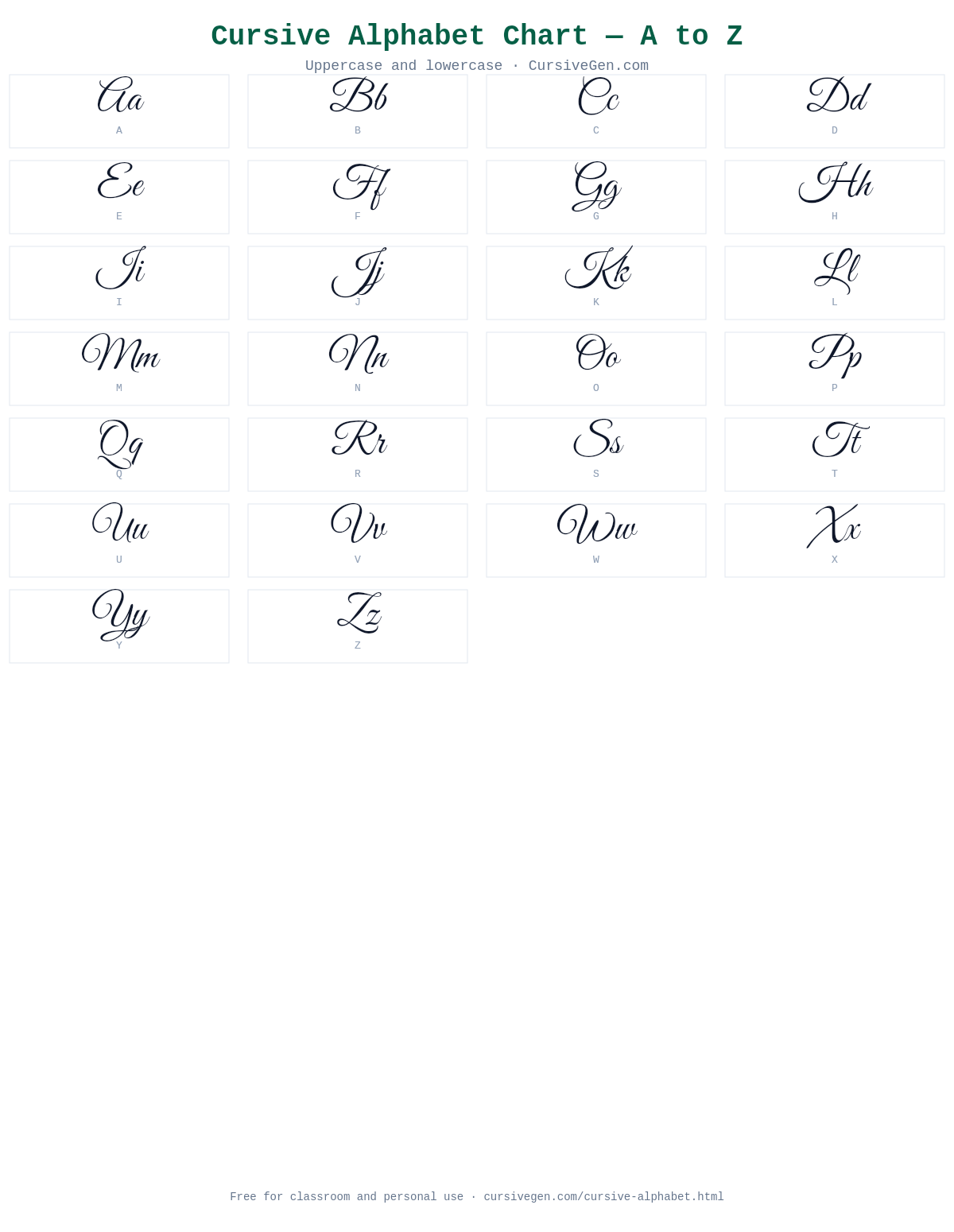
Letter-by-letter guides
Tap any letter for stroke steps, connections, and Unicode copy-paste forms.
The Cursive Alphabet: Your A-Z Guide to Mastering It
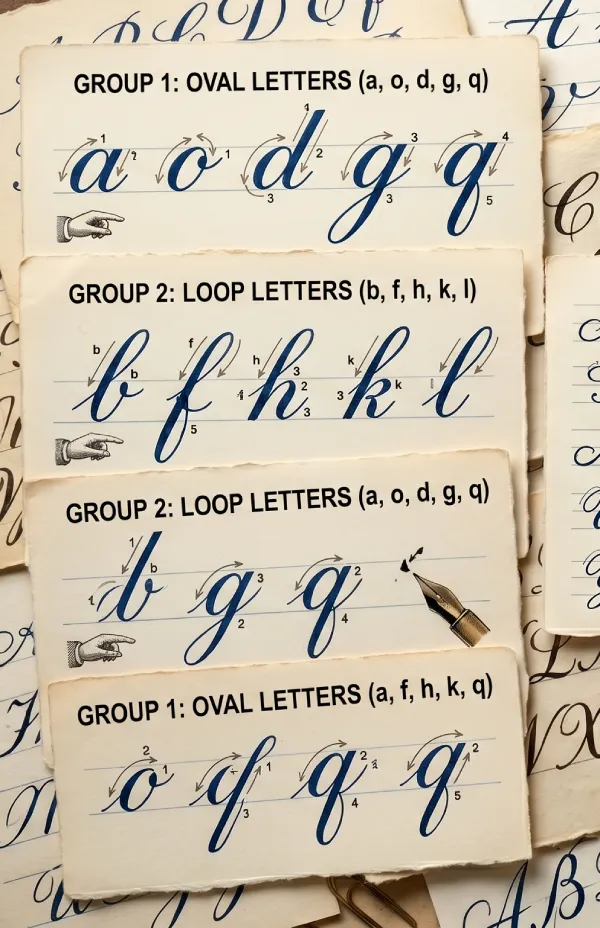
Learning the cursive alphabet is a rite of passage in every student’s education. Our complete guide takes a detailed look at each letter from A to Z, in both upper and lower case. Whether you’re a beginner wanting to begin your handwriting practice or an adult looking to perfect your signature, our cursive letters chart is the ultimate resource for understanding the flow, slant and connection of professional script.
In an age of typing and digital communication, the skill of the cursive alphabet remains an essential one. It’s not just about writing, it’s about cognitive development, historical literacy, and personal expression. Our guide dissects the intricate strokes of cursive into simple steps so you can learn to write in a beautiful and legible style.
Complete Cursive Alphabet Reference
Below is a quick reference for the standard "School Script" used in modern education. Use this as a baseline for your daily practice.
Vowels
- Aa — The basis of the script alphabet.
- Ee — Easy, elegant loop.
- Ii — Short vertical dash with a dot.
- Oo — A perfect circle with an exit at top.
- Uu — Double rhythmic upward strokes.
Complex Letters
- Gg — High loop and deep descender.
- Rr — Needs a soft “shoulder” stroke.
- Ss — Often named as the hardest letter.
- Zz — Has a unique double curve.
How to Write Every Character: Individual Letter Guide
Want to learn how to write a particular alphabet in cursive? Our guide explains all the variations. Here are detailed tips for the most searched script and cursive letters:
Cursive S and F
The cursive s (or s in cursive) has the distinctive shape of a 'boat'. Similarly the cursive f (or f in cursive) is one of the few letters which goes above and below the baseline.
Cursive J, G, Z
The cursive j , g and z (or z in cursive) are all similar in descender loops. The key to flowing script is mastering the g in cursive and j in cursive .
R K & B Cursive
The cursive r needs a sharp 'shoulder' (or r in cursive). The cursive k and cursive b (or b in cursive) have high loops that give character to your writing.
Cursive I, E, and Q
Cursive i is just an upward stroke and cursive e (or e in cursive) is a little loop. The cursive q (or q in cursive) is distinct with its backward loop.
Cursive C, H and D
Learn Cursive h, Cursive c and Cursive d (or d in cursive) to help your sentence flow better. The cursive c is the basis for many other letters.
Cursive P, T & A
The cursive p (or cursive p) has a unique downward stem. The cursive t (or t in cursive) needs to be crossed and the cursive a (or an in cursive) needs to be closed tight.
M, N & W Cursive
The cursive m and cursive n (or n in cursive) have rhythmic humps. The cursive w (or w in cursive) has a high connector stroke at its end.
Cursive V, Y & X letters
The cursive v (or v in cursive) is high. The cursive y (or y in cursive ) has a long tail . The cursive x ( or x in cursive ) is crossed at the end .
O, U & L in cursive
The cursive o (or cursive o) joins at the top. The cursive u (or u in cursive) and cursive l (or l in cursive) are essential to loop consistency.
Consistency is the key to mastering the how to write in cursive method whether you are practicing calligraphy cursive alphabet or looking for fancy cursive letters and cursive bubble letters.
Cursive Upper Case Letters Proficiency
The Capital or Uppercase alphabet letters in cursive are usually the most difficult for beginners to learn because they are very ornate. They are used sparingly mostly at the beginning of names, sentences and titles. Uppercase Cursive: When practicing, the focus is on the “initial stroke” and the “exit stroke”.
The secret of an attractive capital letter is the harmony between the main stem and the ornamental loops. Make sure to use the same slant for letters like A, M, and N. For letters like G, J and Y look for the "descender" loops that go below the main writing line.
Lowercase Cursive Flow Perfection
Uppercase grabs the attention and lowercase cursive alphabet letters do the heavy lifting This is where the speed and efficiency of cursive really shine through. The lower case letters are meant to be written without lifting the pen off the paper.
Practice the “rhythm” of lower case letters. Letters like i, u and w use a rhythmic "up-down" motion. Letters like a, d, g and q have a similar “circle” base. Once you’ve got these shapes down, you’ll be able to write faster and keep everything completely legible.
The Art of Connecting Letters
Connection is the Cursive Alphabet. That is what sets script apart from print. The connections can be of three main types:
- Bottom to Bottom – For most letters (a to n, for example).
- Top to Bottom: For letters that end low (e.g., ‘g’, ‘p’, ‘q’).
- Loop-to-Stem For letters with descenders (e.g. 'j', 'y', 'g')
Once the letters feel natural, see how they join into words in cursive, with ten worked examples.
The Educational Value of Cursive Writing
Cursive demands the brain to integrate motor control with visual recognition in a seamless flow . This "sensorimotor" activity has been associated with improved spelling, because the "feel" of writing a word as a connected whole helps the brain remember the order of the letters. Also, being “cursive literate” enables students to read historical documents like the U.S. Constitution.
Cursive Alphabet FAQ
What is the most difficult cursive letter to learn?
For many the hardest are uppercase 'S' and 'G' - they have complex loops. Lowercase 'z' can be tricky to get right due to its unusual appearance.
Can I make my own cursive style?
For sure! The ideal is to start with a standard Cursive Alphabet chart, but most people tend to develop their own “hand” as they become more comfortable.
Faster to write than print?
Yeah. Since you lift the pen less often, you can usually write more words a minute in cursive than in print.